Continuing the downward trend, retail inflation fell to a five-month low of 4.31 per cent in January, mainly due to a decline in the prices of vegetables, eggs, and pulses. The Consumer Price Index-based retail inflation was 5.22 per cent in December and 5.1 per cent in January 2024. The previous low inflation was in August 2024 at 3.65 per cent.

The Congress took out marches and observed bandh at several places on Saturday to protest against rising fuel prices.

Raise the price of diesel and restrict supply of subsidised LPG cylinder in a year to four per family, Prime Minister's Economic Advisory Panel suggested on Friday.

The Reserve Bank on Friday retained the inflation forecast for 2023-24 at 5.4 per cent, and vowed to take timely measures to prevent any spillovers of global food and fuel price shocks. Stressing that the Reserve Bank has identified high inflation as a major risk to macroeconomic stability and sustainable growth, Governor Shaktikanta Das said the September retail inflation number may be lower than August and July prints. The headline inflation based on Consumer Price Index (CPI) moderated to 4.6 per cent in first quarter of 2023-24 as compared to 7.3 per cent in the same period a year ago.
In five monthly reduction, non-domestic LPG rates have been slashed by Rs 170.5 per cylinder, bringing the price at three-year lows.
Six non-BJP ruled states -- West Bengal, Tamil Nadu, Andhra Pradesh, Telengana, Kerala and Jharkhand -- have not reduced the VAT on petroleum products, leading to higher prices of petrol and diesel there, Petroleum Minister Hardeep Singh Puri said on Thursday. Puri said in Lok Sabha that the central government has reduced excise duty on petroleum products and some other states, following cues, reduced their Value Added Tax (VAT). Six states -- West Bengal, Tamil Nadu, Andhra Pradesh, Telengana, Kerala and Jharkhand -- have not reduced the VAT, he said amidst vocal protests by the opposition members.
Prices of food items like cereals, pulses, and edible oils rose or remained steady in May, a Reserve Bank of India (RBI) report said, indicating there could be another higher inflation print. However, it observed that the Monetary Policy Committee's (MPC's) surprise move to increase interest rates bodes well for its credibility. The RBI's monthly State of the Economy report, released on Tuesday, citing high frequency food price data from the Ministry of Consumer Affairs for the period May 1-12, said the increase in the prices of cereals was primarily because of the surge in wheat prices.
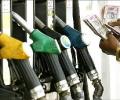
An empowered group of ministers headed by Finance Minister Pranab Mukherjee, which decides on revising rates of the sensitive products, has not met since June last year even though crude oil prices have spiralled upward by about 50 per cent.

Trends in the global energy markets are crucial if India's growth outlook is to remain healthy. Prices for the Indian crude basket were averaging around $86.2 per barrel through Q1FY25 and then moderated to $84 in July and to $78-79 in August (so far). But global crude supply may outpace weak global demand in the short term.

The remarks came after former President Ram Nath Kovind was tasked with the responsibility of heading a committee to explore feasibility of "one nation, one election".

Jet fuel prices on Wednesday were hiked by over 18 per cent -- the steepest ever increase -- to all-time high levels after international oil price surged to a multi-year high.
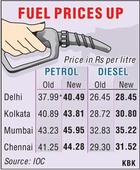
Petrol and diesel prices will go by Rs 2.50 and Rs 2 per litre respectively.

Despite the increase, at Rs 64.32 per litre ATF costs less than petrol and diesel.
The market responded positively to the Q1 results of oil marketing companies (OMCs), Bharat Petroleum Corporation (BPCL) and Hindustan Petroleum Corporation (HPCL) despite numbers being weaker than consensus. BPCL's reported gross refining margin (GRM) was in line at $7.9 per barrel (bbl) in Q1FY25, which implies marketing margin stood at Rs 4.8 per litre. Standalone profit after tax or PAT at Rs 3,000 crore was down versus consensus due to under-recoveries in LPG business.
The scheme will cost the state exchequer altogether Rs 1,650 crore.

India is back on the diplomatic table pushing oil producing countries to raise production in a bid to cool down runaway oil prices. Brent crude oil prices traded above $90 a barrel, on Thursday, for the first time since 2014. Brent is the most popular marker for crude oil trade. It is used as a benchmark for two-thirds of the world's internationally traded crude oil.
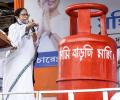
Banerjee, addressing a rally in Siliguri following her protest march over LPG price hike, said the prime minister made many "empty" promises over the years, and people no longer trust him.
Congress president Mallikarjun Kharge has accused the BJP of rigging the Maharashtra assembly elections and called for a return to ballot paper voting. He also criticized the Modi government for selling off public assets, undermining democratic institutions, and promoting communal polarization. Kharge's remarks come as the Congress prepares for its AICC session in Ahmedabad, where it will present its political and economic views.
The Congress hit back at Nadda, saying his letter to Mallikarjun Kharge is a "4D exercise - denial, distortion, distraction, and defamation".
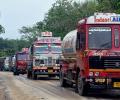
In most parts of the landlocked northeastern state, items such as rice, potato, onion and egg besides LPG cylinders and petrol are selling at rates much above the ones fixed by the government.
Indian govt must find solution to ever increasing LPG subsidy. Govt must cap LPG subsidy.
Ujjwala Yojana was launched on May 1, 2016 at Ballia district in Uttar Pradesh and has so far covered 47.3 million consumers in 715 districts
The government has asked the rich to give up subsidies on LPG to make them available to people who deserve it.

Price of non-subsidised cooking gas (LPG) was today cut by Rs 43.50 per cylinder as international oil rates slumped to their lowest since May 2009.

'I wonder if they will keep it up after the elections.' 'I fear they'll start questioning eligibility -- income, age, bank accounts -- and eventually stop the scheme altogether.'

LPG customers of Bharat Petroleum Corporation Limited (BPCL) will continue to get cooking gas subsidy post-privatisation of the nation's second-biggest fuel retailers, Oil Minister Dharmendra Pradhan said on Friday. "Subsidy on LPG is paid to consumers directly and not to any company. So the ownership of the company that sells LPG is not of any material consequence," Pradhan told PTI. The government gives 12 cooking gas (LPG) cylinders of 14.2-kg each to households in a year at a subsidised rate.
If the LPG consumer does not have an Aadhaar number, he can directly receive subsidy in his bank account without the use of Aadhaar number
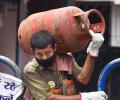
With the price of a cylinder touching Rs 800, it's becoming increasingly unaffordable to an already price-sensitive population, threatening to risk one of the most-celebrated campaigns of the Modi regime, reports Twesh Mishra.

India's fuel sales fell in the first half of April as a record rise in prices in a short 16-day period dented demand, preliminary industry data showed on Saturday. Petrol sales fell almost 10 per cent in the first half of April when compared with the same period in the preceding month, while diesel demand slid 15.6 per cent. Even cooking gas LPG, which had consistently shown growth even during the pandemic period, saw a 1.7 per cent month-on-month fall in consumption during April 1-15.
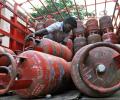
A 14.2-kg subsidised LPG cylinder in Delhi will now cost Rs 507.42 as against Rs 505.34 previously, according to a price notification of State-owned fuel retailers.

Diesel in Mumbai costs Rs 79.72 per litre at IOC outlets and Rs 79.79 at BPCL outlets.
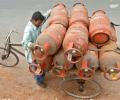
Since international oil prices have fallen, the government's subsidy payout will fall by almost Rs 50 per cylinder to Rs 240.
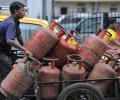
Only 48.3 per cent of the rural households used LPG, while the figures were much higher in urban areas at 86.6 per cent, according to a NSO report.
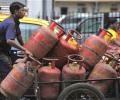
Government gives 3 months, starting June, for the 20 districts to be covered under its direct benefits transfer scheme.

Gehlot made the announcement in the presence of Congress president Mallikarjun Kharge and former party chief Rahul Gandhi at a rally here on the sidelines of the "Bharat Jodo Yatra".

The government on Thursday said it will "look into" a demand to raise the quota of subsidised LPG cylinders to 12 per household in a year from the current limit of nine, a day after the price of non-subsidised LPG was increased by a steep Rs 220.
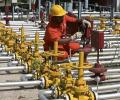
Gail India subsidiary Mahanagar Gas (MGL) on Friday announced a steep reduction in the retail price of compressed natural gas (CNG) by Rs 8/kg and domestic PNG (piped natural gas) by Rs 5/SCM across its licenced area. The move comes on the heels of the Centre revising the pricing methodology of domestically-produced natural gas on Thursday as proposed by the Kirit Parikh committee and following it with the new price announcement earlier in the day. In February, the city gas distributor reduced its CNG price by Rs 2.5/kg but prices are still around 80 per cent more than those in April last.
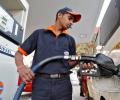
Global oil prices have slumped and India has access to larger amounts of discounted Russian crude oil, yet refiners are not passing on their savings to consumers
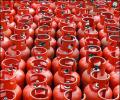
Over 12,450 LPG users have so far voluntarily given up their subsidies, but this accounts for only 0.008 per cent of about 15 crore (150 million) domestic cooking gas consumers in the country.
